

Real haptics
Steering wheel, pedals and switches stay physical – only the environment is virtual. Muscle memory develops as in the vehicle.
Mixed reality
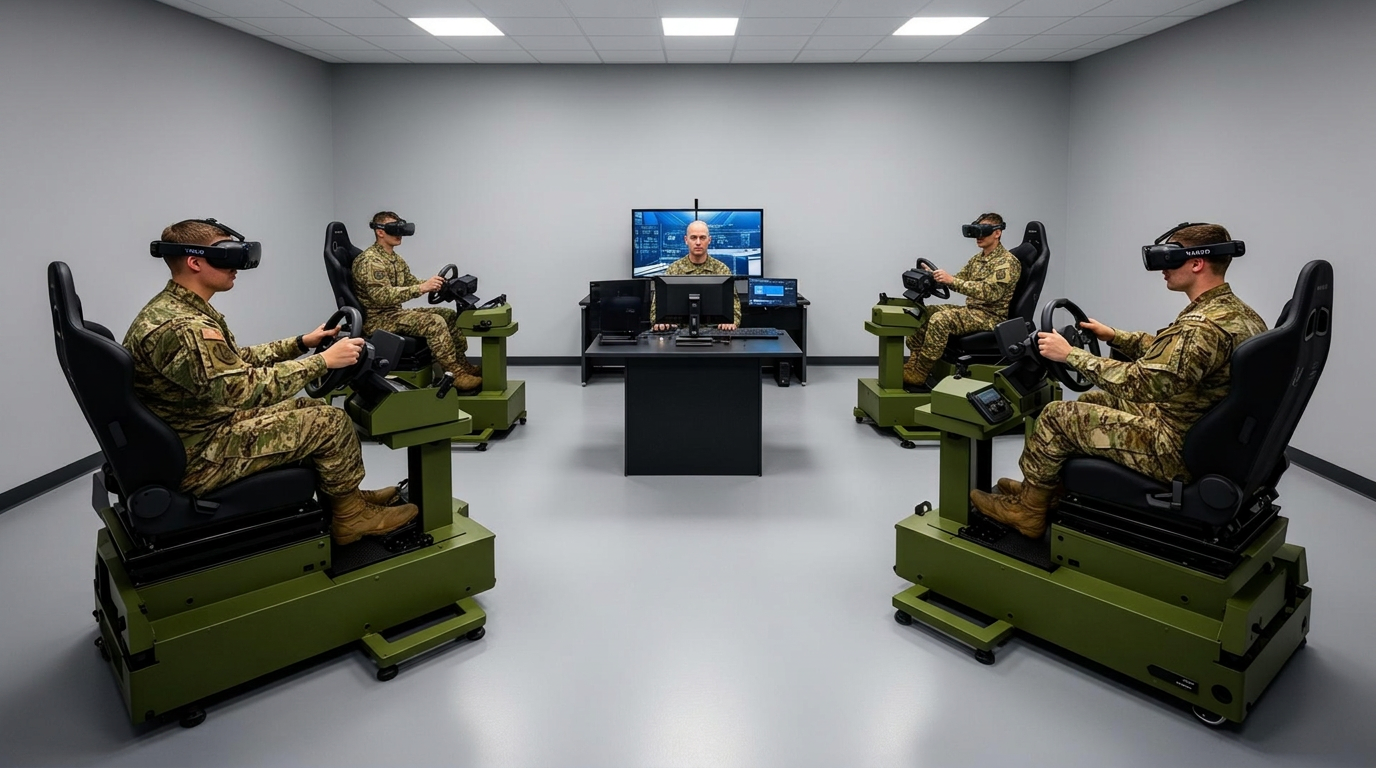
Mixed reality combines real controls with a virtual operational environment. The result is training that fits into a few square metres, adapts to any vehicle type and teaches groups in parallel.
Mixed reality
MR does not replace real driving – it is the bridge to it: more repetitions, more situations, less space and material.
Steering wheel, pedals and switches stay physical – only the environment is virtual. Muscle memory develops as in the vehicle.
Several MR stations fit into an ordinary classroom – ideal for barracks without a hall.
Instructors monitor all stations in parallel, intervene precisely and train as a unit instead of one by one.
Repeating critical sequences without setup time noticeably shortens the path to safe driving competence.
Operational areas, weather, time of day and traffic are adapted to your region and shared between locations.
MR sets can be transported and put back into operation at changing locations within hours.
The instructor sets the learning objective, vehicle profile and scenario – for one station or the whole group.
The driver operates real controls inside the virtual situation; the instructor injects weather, traffic and faults live.
Telemetry, gaze, reaction times and events are logged without gaps.
Replay with flagged events, objective scoring and a progress report per driver.
In MR the real controls stay visible and tangible while the environment is generated virtually. This preserves vehicle-typical haptics with a minimal footprint.
No. One instructor supervises several MR stations at once; autonomous training runs with predefined scenarios are also possible.
Yes. Vehicle profiles, scenarios and scoring logic are identical, so results stay comparable between MR stations and full simulators.
Yes – especially for fundamentals, operating procedures and hazard perception before the first drives in the real vehicle.
Evaluation
The simulator records every drive in full and assesses it objectively – from a single braking manoeuvre to the training progress of an entire unit. Instructors immediately see what worked and what needs work.
Driving behaviour
Speed, acceleration, braking, steering input, lane discipline and distance – logged to the second.
Rule compliance
Traffic rules, blue-light privileges, right of way, signalling and seatbelt use are checked automatically.
Reaction & hazard perception
Reaction times to obstacles, gaze behaviour and decisions under stress are captured.
Vehicle and material care
Engine speed, gear changes, clutch and brake load, fuel consumption and the effect of payload.
Verifiable key figures, each with the basis it relies on.
| Value | Meaning | Basis |
|---|---|---|
| 20+ | years of experience in driving simulation | SIFAT Road Safety GmbH, Berlin |
| 3 | formats: stationary, mobile container, real cabin | Simulators page |
| 100 % | wheeled vehicles – from trucks to 8x8 wheeled armour | Vehicle types page |
| from EUR 5,500 | rental price for 7 days | Rental page, net plus transport |
| ISO 9001 | certified quality management | ISO 9001 page |
External references our statements are based on.
Basis of our certified quality management.
Background on training and vehicle fleet of the German armed forces.
Framework for training, exercises and interoperability within the Alliance.
Benchmark for the accessibility of this website.
The key technical terms on this page, written out and explained.
Direct contact
Select your vehicle type: we instantly show the matching configuration level and the concrete benefits – and you send a prepared enquiry to our sales team with one click.
Select vehicle type
Matching simulator
Compact. Cost-efficient. Ready to use.
Your benefits
Opens a prepared e-mail to sales@sifat.de – including vehicle type and recommended configuration.
Usually answered within one working day – in German, English or Spanish.
Content last reviewed and updated on · Publisher: SIFAT Road Safety GmbH, Berlin (Germany)